
Why arrimundo exists: six stops, one path abroad
Six topics, six points of contact, one foreign language: the path to studying abroad is fragmented. Why arrimundo connects it into a single journey.
On this page
Studying abroad almost always starts with a big feeling. Excitement about a new country, a new language, a life that looks different from the one you know. And right next to it sits a second feeling: overwhelm, the moment it sinks in how many steps lie between the dream and your first day of lectures.
Both feelings are justified. Search for “studying in Germany” for the first time and you’ll find admission rules, visa requirements, language certificates, proof of funds and mandatory insurance — spread across countless websites, often in a language you’re only just learning. For parents who want to support their child from home, it’s hardly any easier.
That’s exactly why arrimundo exists. Not with the promise that everything becomes easy. But with a path that brings order to all those steps.
The real problem: six topics, no connection
The path to studying abroad is fragmented. Orientation, language, funding, study preparation, coverage, arrival — six topics, six points of contact. Each topic has its own rules, its own deadlines and its own jargon. And almost no one ever explains how their topic connects to the others.
Yet that’s exactly where the biggest hurdle lies: the steps depend on each other. Three examples from Germany:
- No blocked account, no visa. For the student visa you have to prove your living costs are covered. In 2026 that means €11,904 in a blocked account, from which you can withdraw €992 a month after you arrive.
- No health insurance, no enrolment. The university requires proof of insurance before you can enrol.
- No Studienkolleg without the right language level. Public Studienkollegs usually expect at least B1 before you can sit the entrance exam.
If you don’t know about these dependencies, you do the steps in the wrong order — and lose time. The application to a Studienkolleg alone takes three to six months. If your language certificate or proof of funding is missing at that moment, everything quickly slips by a semester.
Then there’s the language. A lot of official information exists only in German, often in dry officialese. If you’re still at A2, you’re expected to understand terms like “Feststellungsprüfung”, “Sperrbetrag” or “Versicherungspflicht” — and make decisions on that basis with a whole year riding on them.
For parents, there’s something else on top: they’re expected to help decide and often help pay — based on information they can barely verify themselves. Nobody opens a blocked account with €11,904 in it lightly. If you understand what each step is for and in what order it comes, you decide with a calmer head.
So the problem isn’t that there’s too little information. If anything, there’s too much. What’s missing is the map: the order, the dependencies, the overview.
The journey: six stops, in chronological order
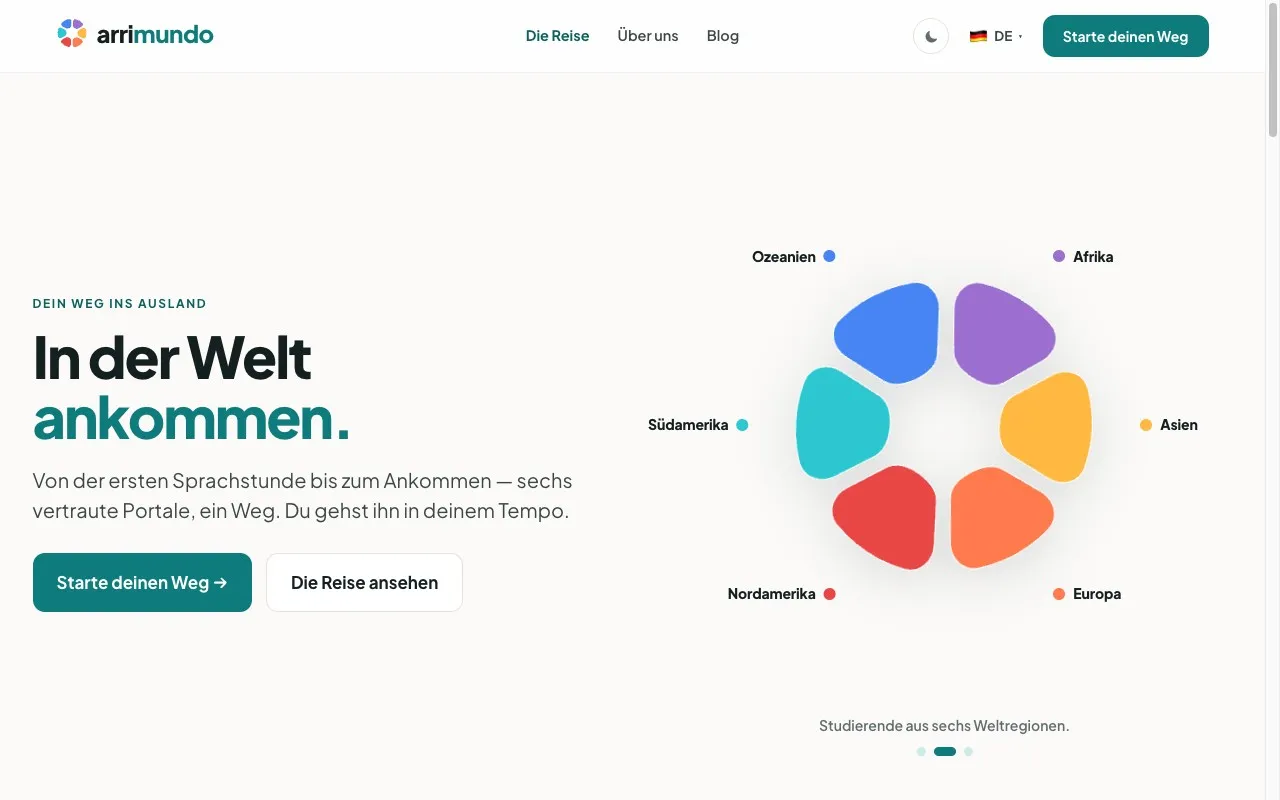
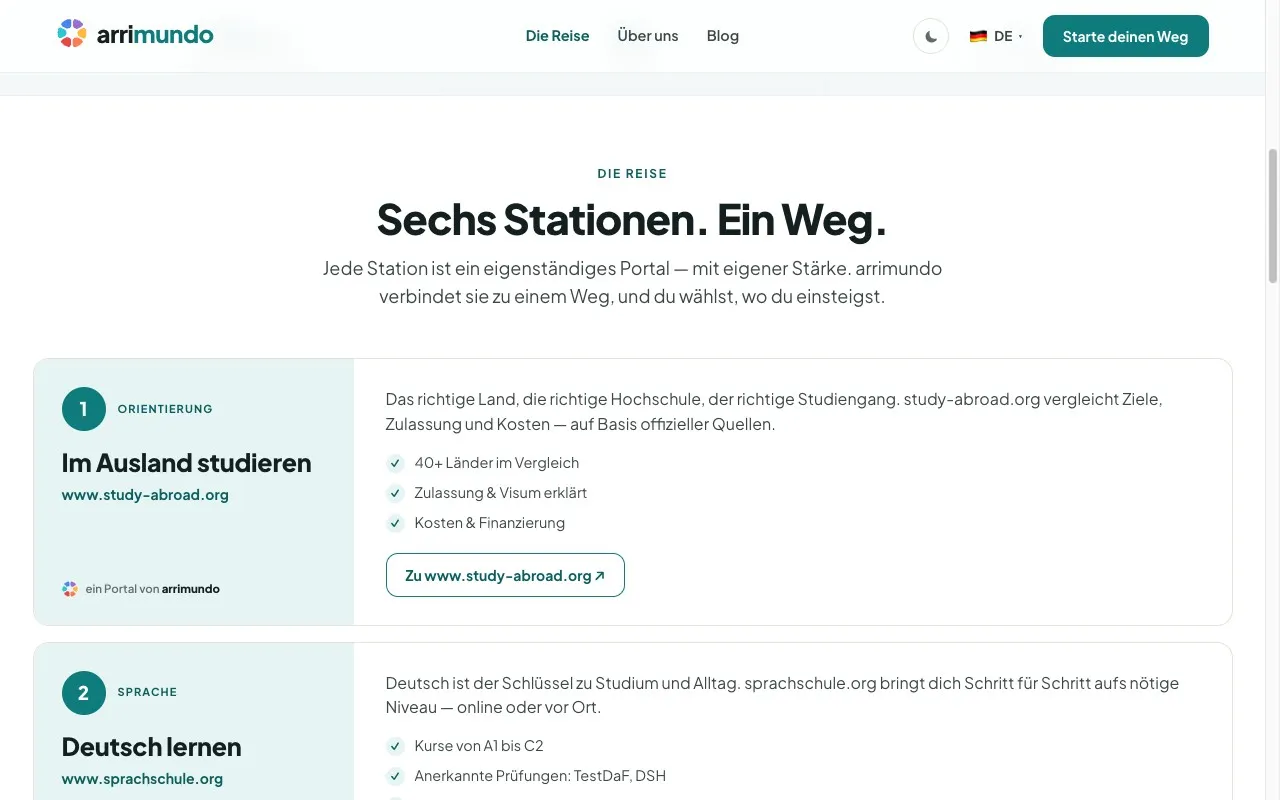
arrimundo organises the path as a journey with six stops. Behind each stop is an independent portal that does exactly one thing really well. Together they form the order that nobody knows at the start. And you don’t have to begin at stop 1: if you’re already learning German or preparing your visa, you simply jump in wherever you are.
Stop 1: Orientation
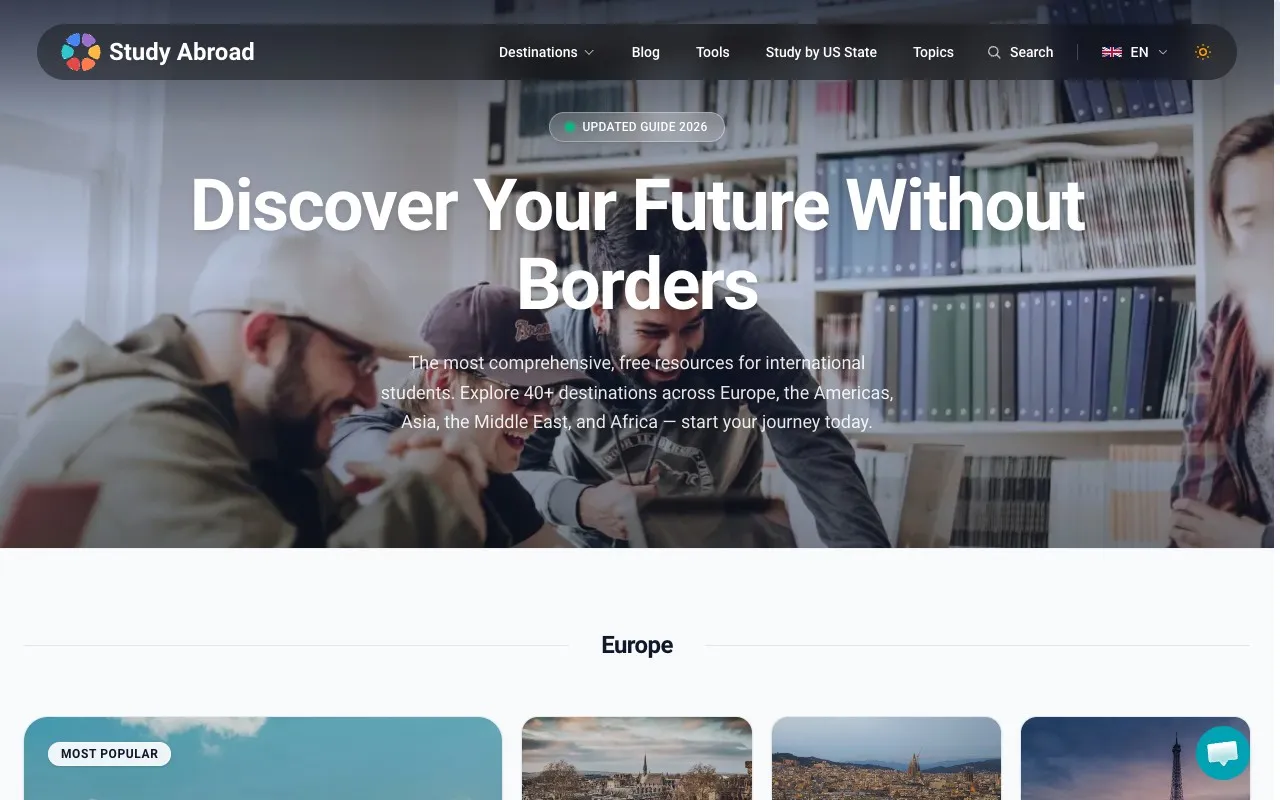
At the beginning come the big questions: which country, which university, which programme — and what does it all cost? www.study-abroad.org compares more than 40 study destinations, explains admission and visas, and draws on official sources like the DAAD and the relevant authorities. Free calculators help you get a realistic picture of the costs in specific cities — before you commit. The portal is available in ten languages: you can start in your own language and work your way towards German step by step.
Stop 2: Language
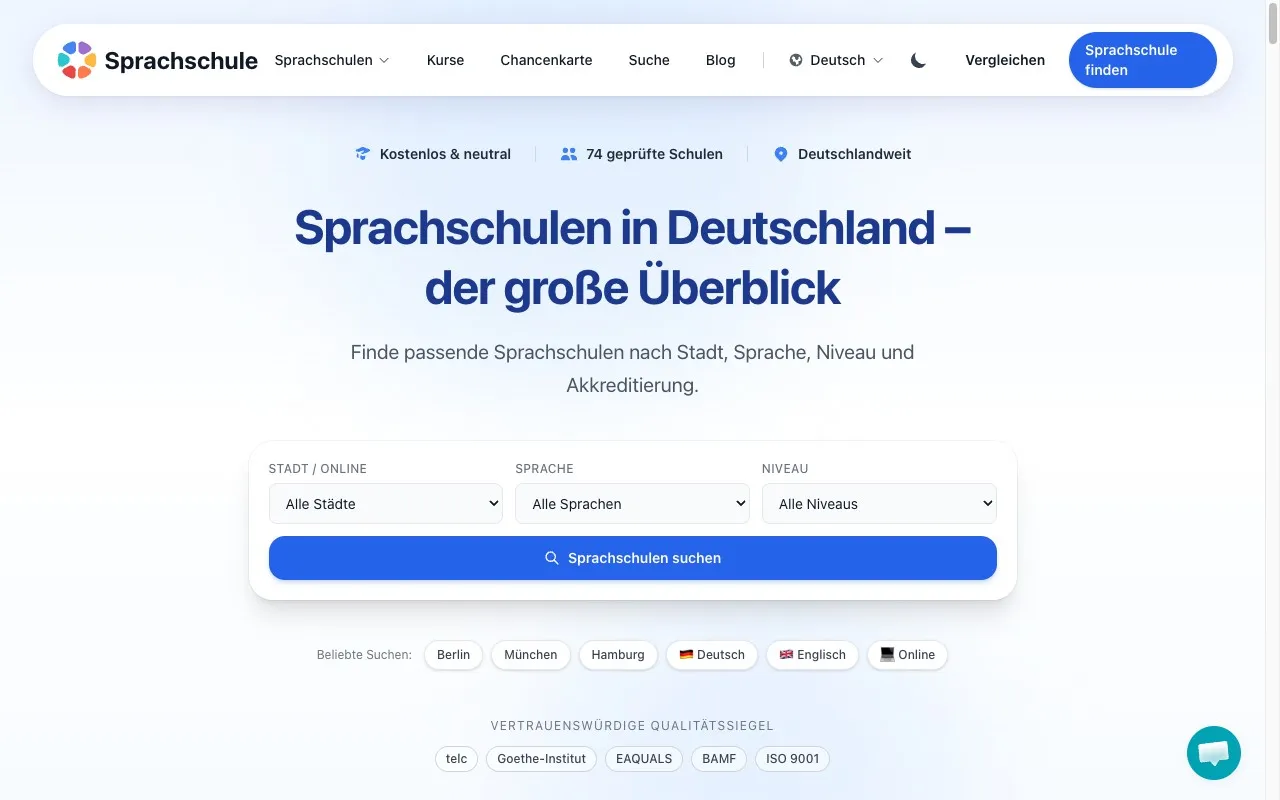
Language is the key to your studies and everyday life — and it needs the longest lead time. www.sprachschule.org helps you find and compare language schools in Germany: 74 vetted schools, course levels from A1 to C2, plus guides to recognised exams like TestDaF, DSH, telc and the Goethe-Zertifikat. And because honesty is part of the deal: a private intensive course costs €350–900 a month. There are ways to bring that down, though — such as the subsidised integration course or the Bildungsgutschein (education voucher), both explained on the portal.
Stop 3: Funding
No blocked account, no visa — which is why the money comes before the visa application. www.flexblocked.com explains the German blocked account (€11,904 for 2026), the proof of funding, the choice between public and private health insurance, and the German bank account — in plain language, with references to official sources. The portal launches soon; the most important numbers and answers are already there today.
Stop 4: Preparation
Not every school-leaving certificate qualifies you to study in Germany right away. In that case, the path leads through a Studienkolleg (preparatory college): a year of academic and language preparation, ending with the Feststellungsprüfung (qualifying assessment). www.studienkolleg.org lists 46 state and private Studienkollegs, explains all nine course types and gathers more than 100 sample exams to practise with. The uncomfortable numbers are there too: state Kollegs are usually tuition-free with a semester fee of €100–350, while private ones cost €3,500–6,500 per semester. Important for your planning: the application windows are fixed — for the winter semester, the deadline at public Kollegs runs from 15 January to 15 July.
Stop 5: Coverage
No health insurance, no enrolment. www.student-insurance.com compares visa-compliant health insurance for international students in 35 countries and explains what the university requires — and what’s in the fine print. For Germany, that means, for example: public health insurance costs around €141 a month for students under 30. According to the portal, the application takes just a few minutes online, and the insurance certificate for the university usually arrives within 24 hours.
Stop 6: Arrival
Once the visa is in your passport, everyday life is only just beginning: registration and authorities, housing and a bank account, language and community. www.living-abroad.org walks you through the first weeks — so the new country becomes a home. This portal is still being built. The stop has been part of the journey from day one all the same, because arriving is more than just getting there.
Why one connected path beats six separate ones
Each of these portals works on its own. So why put a roof over them? Because the hardest questions sit between the topics: What comes first? What depends on what? How much lead time does each step need? And that’s exactly where a standalone portal leaves you on your own.
A connected path gives you four things:
- A common thread. You see where you stand and what comes next. No more guessing whether the blocked account or the insurance comes first.
- Verified sources, dated. We point you to authorities, the DAAD and universities — and we date what we say. So you can check for yourself whether a figure is still current.
- Plain language. Our content is written for non-native speakers: short sentences, clear steps, no jargon. We even translate the fine print of insurers and authorities into words you can understand.
- Self-service at your own pace. You find what you need yourself — no appointment, no sign-up, no pressure. If you’re already partway along, you simply jump in at your stop.
Connected also means the topics interlock — and that’s exactly how we treat them. Sort out your blocked account and you’ll already run into health insurance there. Apply to a Studienkolleg and you’ll know which language level is required beforehand. The stops point to each other instead of pretending their topic is the only one.
More than a million students use our portals every year. arrimundo turns all those individual answers into one connected path.
What arrimundo is — and what it isn’t
arrimundo is a roof and a companion. The six portals stay independent, each with its own strength and its own focus — a language-school comparison talks to you differently than an insurance comparison, and that’s a good thing. What they share is the standard for sources, the plain language and the honesty. arrimundo connects the portals into one path and makes sure you don’t get lost between the stops.
Just as important is what arrimundo is not. We don’t walk the path for you. The forms are still forms, the deadlines are still deadlines, the exams are still exams. Studying abroad costs time, money and nerves — and we’d rather tell you that before than after. Our principle: honest, even when it’s uncomfortable. We also name what gets difficult or expensive, not just what sounds good.
The name sums up that promise. arrimundo comes from three Romance roots: arrivo and arribar mean to arrive, mundo is the world, and arrimo means support, shelter, a steady hand. Together: to arrive in the world, with support. You can find out more about us and our principles on the About page.
Your first step
You don’t have to sort everything out today. It’s enough to figure out where you are on the journey — and take the one next step.
Two good places to start:
- Take a look at the journey on the homepage and find your stop.
- Read our study-abroad timeline. It shows you when each step is due and how much lead time to plan for.
Both are free, with no sign-up.
The path is long, but you can walk it. And you no longer have to sort it out alone.
Keep reading
Your study abroad timeline: 18 months, six stops
From comparing countries to registering in your new city: a realistic study abroad timeline in five phases — with the right portal for every step.
Inside study-abroad.org: where your path abroad begins
study-abroad.org is stop 1 on the arrimundo journey: free guides to 40+ study destinations, two calculators and facts from official sources to get you started.
Inside sprachschule.org: finding the right language school
Stop 2 on the arrimundo journey: sprachschule.org helps you find and compare language schools in Germany — free, neutral, and with real numbers.
Ready for the next step?
Six stops, one path — find out where you stand right now.